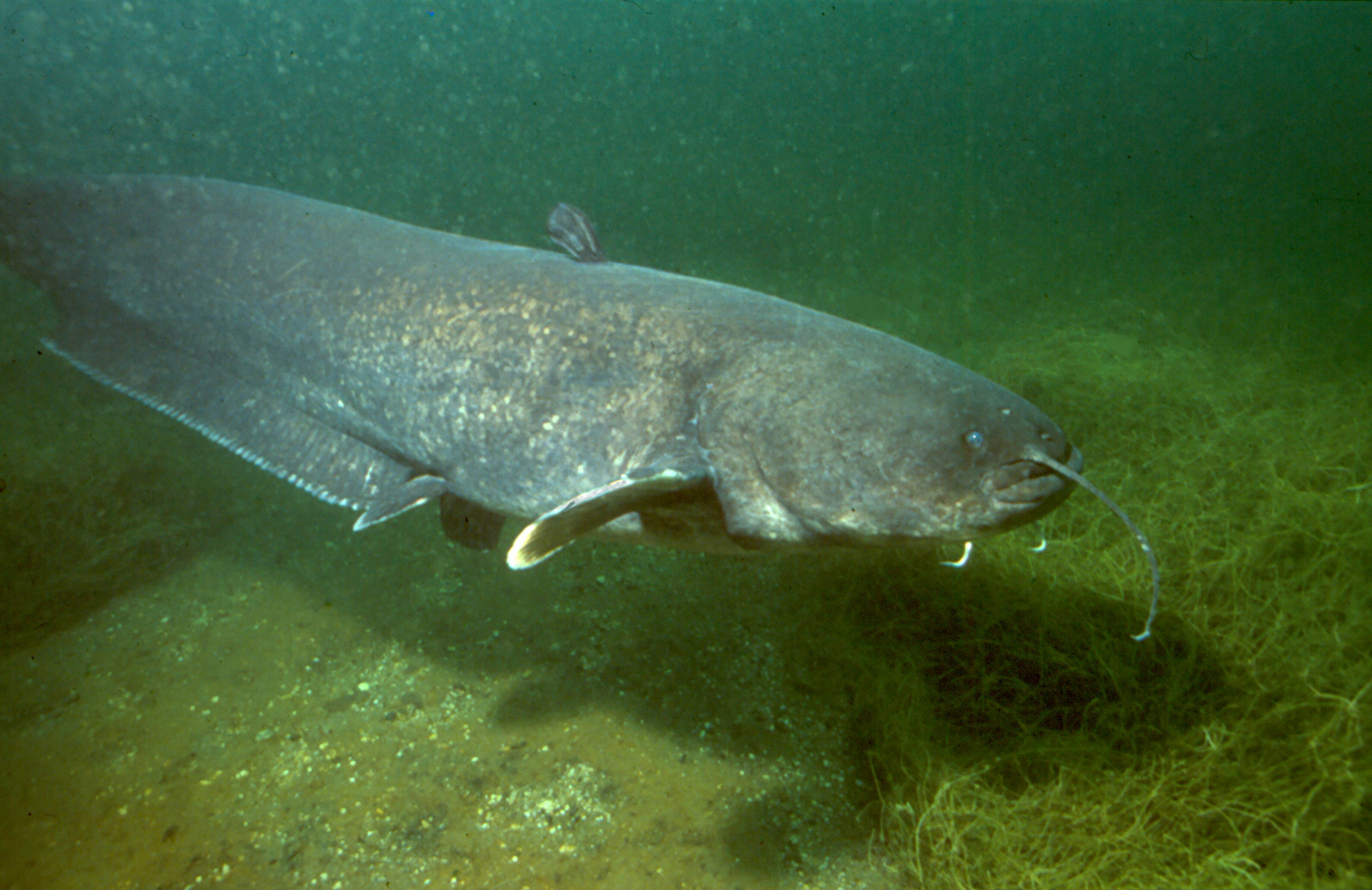
Physical Characteristics
The catfish has an unmistakable and impressive appearance, perfectly adapted for the life of a nocturnal predator in the deep holes of waters. The body is elongated, massive, cylindrical in the anterior part (up to the dorsal fin) then slightly compressed laterally toward the tail, offering excellent hydrodynamics for maneuvering in tight spaces. The most distinctive feature is the enormous head, large, wide, and strongly flattened dorso-ventrally (flattened), equipped with an immense mouth capable of swallowing prey of remarkable dimensions. The mouth opens from above ("it rains in my mouth"), which shows that the catfish takes its food from between waters and from the surface, not from the bottom, and the older the fish gets, the longer the lower jaw becomes than the upper one.
The mouth is armed with numerous small, sharp, and dense teeth, arranged in several rows like a brush on thick bone plates, making it difficult to hook with hooks (requires very sharp hooks and great hooking force). The most characteristic features are the six barbels: two very long barbels on the upper jaw (can reach over 1 meter in large specimens) and four shorter barbels on the lower jaw - these barbels are extremely sophisticated sensory organs, full of taste papillae and tactile receptors, allowing prey detection in turbid waters or at night.
The body is completely scaleless, being covered with a thick layer of protective mucus that gives it the characteristic slippery appearance. Coloration varies enormously with habitat: the back and flanks are grayish-green, olive-green, dark brown or almost black, often with marbling or lighter spots, while the belly is dirty-white, yellowish or cream. The dorsal fin is very small and situated very far toward the anterior part, the anal fin is long and continues almost to the caudal fin which is rounded. Average dimensions are 80-150 cm and 10-30 kg, but exceptional specimens exceed 2.5-3 meters and 100-200 kg.
Habitat & Distribution
The catfish is a strictly benthic fish that prefers the deepest areas of aquatic systems, being an inhabitant of holes, deep channels, and areas with irregular underwater relief. In the Danube Delta and lower Danube, catfish occupy habitats with the greatest available depths: deep holes and pits of the main branches (10-30 meters depth), maritime canals and navigation channels, confluence zones where currents dig deep holes, and larger lakes with deep areas. It prefers calm waters or with very slow current, never fast or muddy waters too shallow.
During the day, catfish stay hidden in shelters: deep holes and pits, under sunken trees and logs, in hollows of steep muddy banks, under artificial structures (bridge pillars, wrecks), or even partially buried in the mud on the bottom during periods of inactivity. It is an extremely sedentary and territorial fish, with large adults occupying a preferred "hole" which they defend aggressively and to which they constantly return after nocturnal hunting excursions. At night they become active and patrol the territory or move to feeding areas - banks with vegetation, areas with concentrated small fish, water surface where they attack birds. Toward the end of autumn (October-November), catfish gather in large numbers in the deepest holes where they spend winter buried in mud or in hollows of underwater structures, in a state of lethargy with reduced metabolism. They tolerate a wide range of temperatures (from nearly 0°C to over 28°C) but the activity optimum is 15-25°C.
Behavior & Feeding
The catfish is an extremely voracious and non-selective opportunistic predator, a carnivore that consumes practically any animal-origin prey it can swallow. The diet varies enormously with fish size and prey availability: fish of any species (crucian carp, roach, rudd, bream, common carp, perch, pike, even smaller catfish - cannibalism is frequent), crustaceans (crayfish, shrimp), mollusks, amphibians (frogs, newts), aquatic reptiles, water birds (ducks, geese, coots - surface attacks), small mammals (mice, rats, even swimming cats or dogs), and decomposing carcasses ("janitor" role - consumes dead or dying fish, drowned animals).
Larger catfish can swallow fish up to 30-40% of their own weight. The feeding strategy combines passive ambush with active hunting: during the day they stay perfectly immobile and camouflaged in their hole, using long barbels as "live bait" to attract curious fish that are swallowed instantly when they approach too close; at night they become much more active, patrolling the territory and systematically hunting in areas with prey concentrations. The senses are extremely developed for nocturnal hunting: barbels function as incredibly sensitive chemical and tactile detectors, the sense of smell is extraordinary (can detect blood and decomposing meat from great distances), the lateral line detects vibrations from the slightest movements in water, and hearing is very fine (catfish can even hear noises made by anglers on shore or in boats).
Life Cycle & Reproduction
Catfish reach sexual maturity relatively late, which contributes to their vulnerability to overfishing: males at 4-5 years when they are 60-80 cm, females at 5-6 years when they are 80-100 cm. Reproduction occurs in May-June, when water temperature reaches 17-18°C (optimum being 20-22°C). Catfish migrate from deep holes to shallow areas (1-3 meters), calm and sheltered, with dense vegetation, roots, or other structures that can serve as a nest.
The male chooses and prepares the nest location - usually a natural cave, a hole in the bank, under roots or logs, which he meticulously cleans. Nest cleaning and reproductive behavior include spectacular "attacks" in which the male hits the female with his head and they bite each other, a prelude lasting several hours, usually in the evening. Fecundity is impressive: the female deposits approximately 25,000-30,000 eggs per kilogram of body weight (a 10 kg female deposits ~250,000 eggs, one of 50 kg over 1 million, and giants of 100+ kg can deposit over 2-3 million eggs). The eggs are relatively large (2.5-3 mm diameter), yellowish-orange, sticky and adhere to the substrate in compact piles.
The male spreads milt over the eggs, then the female immediately leaves the nest while the male remains to defend the nest with extreme aggression against any intruder, for 4-7 days until hatching. The larvae are extremely sensitive to sunlight, diseases and parasites, and mortality in the first weeks is very high (over 95%). After 10 days the larvae begin consuming external food - initially water fleas and aquatic beetles, then rapidly crustaceans and fish fry. Growth is rapid in the first year (up to 30 cm and 500 grams), after which it slows but continues constantly throughout life. Cannibalism occurs frequently, with larger specimens consuming smaller catfish. Extraordinary longevity (50-80+ years) and continuous growth allow reaching gigantic dimensions in very old specimens.
Conservation Status
The catfish is classified as "Least Concern" (LC) by IUCN globally, being a widely distributed species in Central and Eastern Europe, Western Asia, and the Ponto-Caspian basin. In the Danube Delta and lower Danube basin, populations are healthy and stable, with catfish being one of the more abundant predatory fish in suitable habitats. However, the species benefits from protection measures in Romania: minimum legal retention size of 50 cm (ensures fish have had at least one spawning season), closed season for reproduction (May-June), and catch limits for recreational fishing.
Catfish play an extremely important ecological role as "janitor fish" - consuming sick, dead, dying, or injured specimens of other species, eliminating carcasses that would otherwise pollute the water, and keeping excessive populations of small fish under control. In carp farms and ponds, the presence of a few catfish is beneficial for eliminating sick fish and unwanted species. Local threats include: overfishing of large breeding specimens (a 100 kg catfish of 40-50 years represents a huge genetic loss for the population), habitat degradation (destruction of deep holes through dredging, channel siltation), water pollution that especially affects sensitive larvae, and illegal fishing with destructive methods (explosives, electrofishing). Sustainable management requires strict protection of very large trophy specimens (which are the most productive breeders), maintenance of deep holes and spawning areas, pollution reduction, and angler education about the value of conserving giants.
Sources