Fish

Common Stingray

Dasyatis pastinaca

Common Stingray

Overview

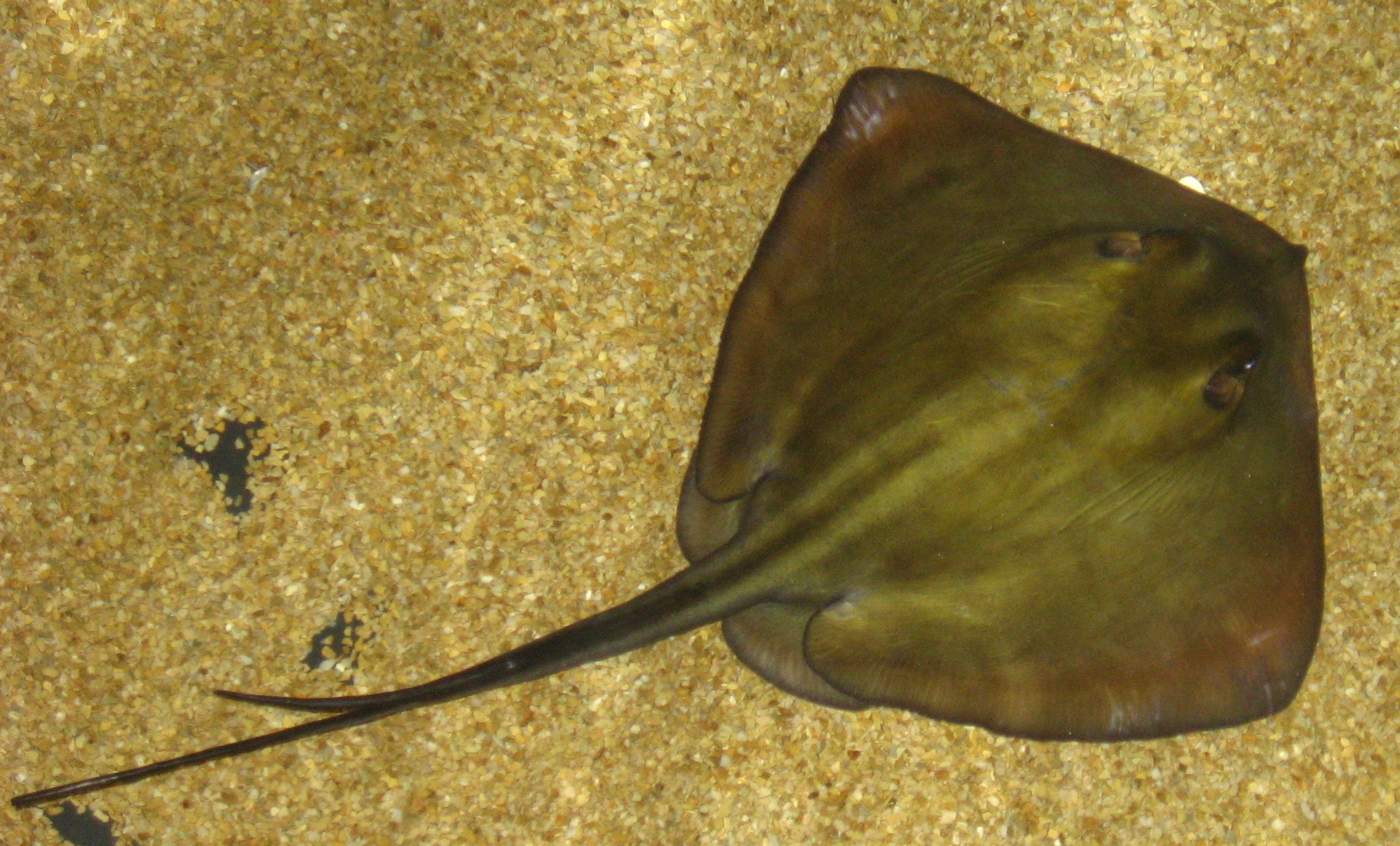
The common stingray (*Dasyatis pastinaca*) is a cartilaginous fish related to sharks, with a characteristic flattened body. It is especially known for the venomous spine on its tail, which constitutes an effective defence weapon. In the Black Sea, it is a common presence on the continental shelf, being a solitary species that spends most of its time on the sea floor.

Physical Characteristics

The body has a rhomboid shape (disc), being wider than long, with rounded edges of the pectoral fins. The skin is smooth, greyish-brown or olive-coloured on the dorsal side and whitish on the ventral side. The tail is long, whip-like, and bears one or more sharp spines on the dorsal side, equipped with retroserrated barbs and venom glands at the base.

Habitat & Distribution

It is widespread in the North-East Atlantic, Mediterranean and Black Seas. It prefers shallow waters with sandy or muddy bottom, from the coastal zone down to 60-100 metres depth. In the Delta region, it can be encountered in the marine sector in front of the river branches, approaching the shore in summer when waters are warm.

Behavior and Feeding

The common stingray is a nocturnal benthic predator. It feeds by "rooting" through the substrate, using its disc to stir up the sand and bring prey to the surface: crustaceans (crabs, shrimps), polychaete worms and small bottom fish. It is not an aggressive fish; the spine is used exclusively for self-defence when stepped on or handled carelessly.

Life Cycle & Reproduction

It is an ovoviviparous species (aplacental viviparity). The embryos develop inside the uterus, feeding initially on yolk and later on a nutritious fluid ("uterine milk") secreted by the mother. After a gestation of approximately 4 months, the female gives birth to 4-9 live young, fully formed, measuring about 15-20 cm in diameter.

Conservation Status

Although globally listed as "Data Deficient" (DD), there are concerns about population decline due to accidental captures in trawls and seines. In Romania, it is not a target of directed fishing, but specimens caught accidentally are often killed by fishermen out of fear or to avoid injury from the venomous spine, which affects the local population status.