Fish

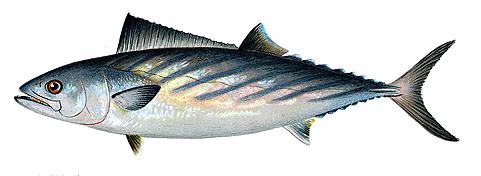
Atlantic Bonito

Sarda sarda

Atlantic Bonito

Overview

The Atlantic bonito (*Sarda sarda*) is a medium-sized marine predatory fish, related to tuna and mackerel. It is an epipelagic and migratory species, renowned for its speed and excellent culinary qualities. In the Black Sea, its presence is seasonal, being conditioned by the movements of the small fish schools it feeds on and by variations in water temperature.

Physical Characteristics

The body is elongated, robust and strongly laterally compressed, adapted for fast swimming over long distances. The dorsal colour is steel-blue, with 5-11 characteristic oblique black stripes descending towards the lateral line. The mouth is wide, armed with relatively large conical teeth, and the dorsal fins are almost united, giving it a perfect hydrodynamic silhouette.

Habitat & Distribution

This species lives in the tropical and temperate waters of the Atlantic Ocean, as well as in the Mediterranean and Black Seas. In the Danube Delta area, the bonito can be encountered in the marine sector off the Romanian coast, migrating from the Bosphorus northwards during the warm months for feeding. It prefers open waters but may approach the shore in pursuit of prey.

Behavior and Feeding

The bonito is an active and voracious predator that hunts in large groups. Its diet consists mainly of small schooling fish such as anchovy, sprat and horse mackerel, but it also consumes cephalopods or pelagic crustaceans. It is known for its "surface hunting" behaviour, where schools of bonitos force small fish to rise to the upper water layer.

Life Cycle & Reproduction

Sexual maturity is usually reached at the age of 2 years. Reproduction takes place in the upper layers of the water, during May-July, when females lay a large number of pelagic eggs. Larval development is rapid, with fry growing quickly in the first months of life to cope with seasonal migrations to warmer wintering areas.

Conservation Status

The species is classified as Least Concern (LC) globally. However, Black Sea populations may suffer major fluctuations due to industrial fishing pressure and changes in food availability. It is an important species for commercial and sport fishing, valued for its red meat rich in healthy fats.