Physical Characteristics
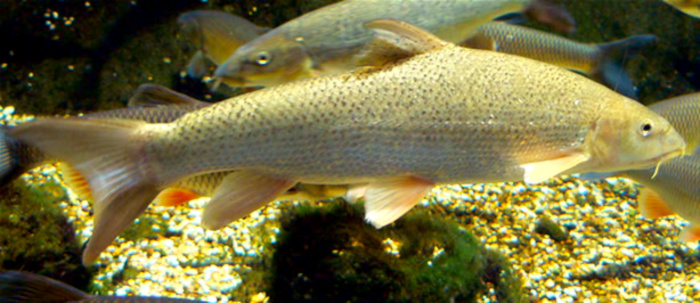
The common barbel has an elongated, cylindrical, robust, and muscular body - perfectly adapted for powerful swimming in fast current. The head is characteristic: prominent and conical snout, large mobile mouth with well-developed fleshy lips, positioned inferiorly - a perfect adaptation for benthic feeding. The most distinctive feature is the four sensory barbels arranged around the mouth: two shorter ones on the upper lip and two longer ones at the corners of the mouth. These barbels are rich in chemical and tactile receptors, allowing the barbel to detect food on the riverbed even in complete darkness.
Coloration is elegant: olive-green or light-brown back, silver-grey flanks with intense golden or bronze reflections, yellowish-white or cream belly. The pectoral and ventral fins are reddish or orange. Average dimensions are 40-60 cm and 800 grams-1 kg, but large specimens frequently reach 70-80 cm and 2-4 kg.
Habitat & Distribution
The common barbel is an obligate rheophile living exclusively in flowing waters with good oxygenation and moderate to fast current. In the Danube Delta, it is present but localized, occupying exclusively the main Danube arms where current is constant and moderate (the Chilia arm especially), maritime and navigation channels, and confluence zones. Unlike most delta species seeking still waters, the barbel completely avoids ponds, lakes, and currentless channels.
Ideal habitat includes: moderate depths, exclusively hard bottoms - stony, gravelly, sandy (completely avoids muddy bottoms), moderate to fast current, well-oxygenated water, presence of hiding spots. The barbel is a strictly benthic fish. In spring it undertakes spectacular upstream reproduction migrations. It tolerates temperatures between 0°C and over 25°C, with the optimum being 15-20°C.
Behavior & Feeding
The common barbel is a specialized benthic omnivore feeding almost exclusively on the riverbed, extremely efficient at detecting and capturing prey using its sensory barbels. The diet is predominantly carnivorous: large aquatic insect larvae (mayflies, caddisflies, chironomids, stoneflies), crustaceans (gammarids, ostracods), mollusks, worms, earthworms, terrestrial insects, fish eggs, and occasionally fish fry. Feeding mode is characteristic: the barbel uses the current as a food "conveyor", positioning itself strategically behind obstacles and intercepting food brought by the water.
Feeding activity is intense in the early morning (4-9 AM) and evening (6-11 PM). The barbel is a powerful and resilient fish, an extraordinary fighter when caught - using the current to its advantage. Social behavior varies with age: juveniles form small groups, but adults are more solitary and territorial.
Life Cycle & Reproduction
The common barbel reaches sexual maturity relatively late: males at 3-4 years when 25-35 cm, females at 4-5 years when 30-40 cm. Reproduction takes place in spring and early summer, between April and June, when water temperature reaches 14-20°C. The barbel undertakes spectacular reproduction migrations, gathering in groups and migrating upstream to zones with fast current and gravelly bottoms.
Fecundity is moderate: a female lays 5,000-15,000 eggs (average 10,000-12,000). Eggs are yellow-orange, slightly sticky, and fix to stones or gravel. Warning: Barbel eggs are TOXIC and NOT edible! Hatching occurs after 6-10 days. Growth is moderate: in the first year 8-12 cm, in the second 15-20 cm, in the third 25-30 cm.
Conservation Status
The common barbel is classified as "Least Concern" (LC) by IUCN globally, but populations are in moderate decline in many regions. In Romania, it is relatively common in rivers with suitable habitat, but rarer in the Danube Delta where optimal habitat is limited. It benefits from moderate protection: minimum legal retention size of 27 cm, reproduction prohibition period (April-June).
Main threats are significant: hydrological modifications (dams fragment populations and block reproduction migrations), water pollution, eutrophication, overfishing (the barbel is sought by sport fishermen but its slow growth makes it vulnerable), and loss of spawning areas through gravel extraction from rivers. Sustainable management requires maintaining natural fast-current habitats with hard bottoms, protecting spawning areas, and ensuring river connectivity.
Sources