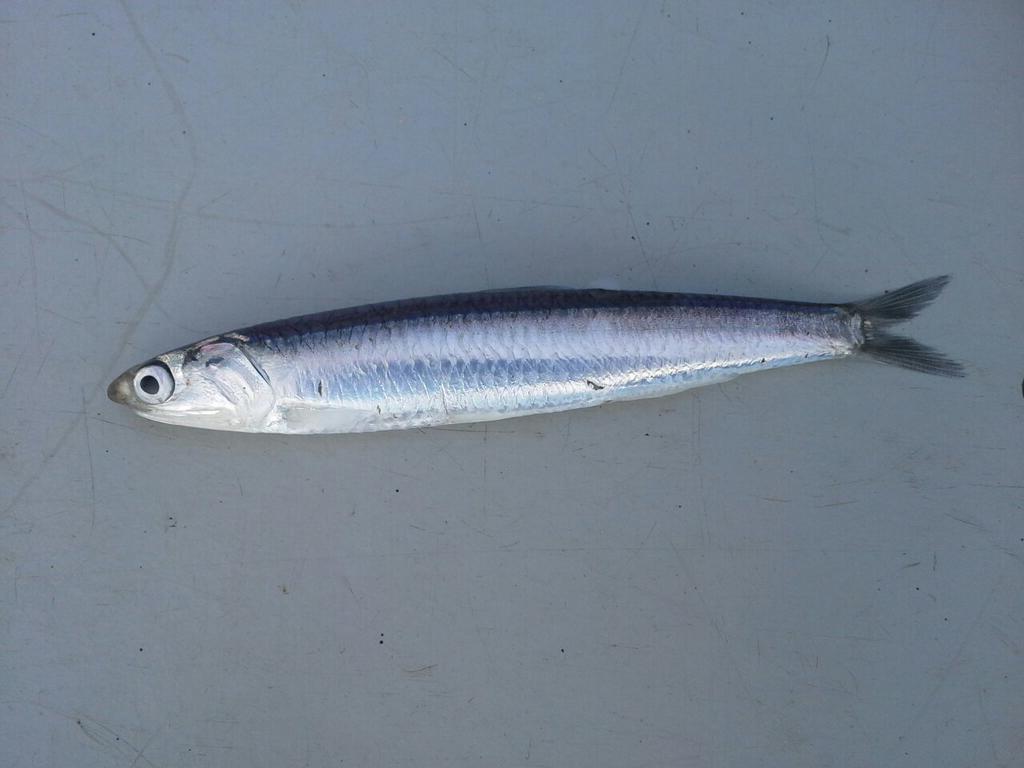
Physical Characteristics
The anchovy has a fusiform (spindle-shaped) body, moderately elongated and laterally flattened — typical of an open-water pelagic fish that swims rapidly in schools. The head is moderately large, with a characteristic pointed and prominent snout. The most distinctive and immediately recognisable feature is the extremely large mouth, which opens far behind the eyes — the mouth gape extends practically to the gill covers, giving the head a characteristic "open" or "wide" appearance. The upper jaw is considerably longer than the lower jaw. Both jaws are equipped with numerous small, fine teeth used for filtering plankton. The eyes are large and round. The scales are small and deciduous (they fall off easily when handled), arranged in pairs on the tail — a specific taxonomic characteristic. Coloration is characteristic of pelagic fish: iridescent blue-green or blue-grey back, with brilliant silver flanks and belly (typical counter-shading camouflage — dark above, light below — for open water). A narrow, brilliant silver stripe often runs along the flank from head to tail. Usual dimensions are 12–14 cm and 10–20 grams, maximum 20 cm and 25–40 grams. The Black Sea subspecies (E. e. ponticus) is slightly smaller than the Mediterranean one.
Habitat & Distribution
The anchovy is a euryhaline pelagic marine species (tolerating large salinity variations), distributed along the eastern Atlantic coasts from Norway to South Africa, throughout the Mediterranean and the Black Sea, with presence in the Sea of Azov. The Black Sea form (E. e. ponticus) occupies the entire Black Sea basin. The typical habitat is the pelagic water column, from the surface to moderate depths. In the Black Sea and the vicinity of the Danube Delta, the anchovy follows a distinct seasonal cycle: in summer (April–September) it approaches the coast, moving northward, swimming near the surface in shallow coastal waters — massive schools are frequent near the Romanian and Ukrainian coastlines, including the Danube mouth area. In autumn, as the water cools, adult schools head offshore and descend to depths of 50–70 metres, moving toward the southern Black Sea where they overwinter. In spring they migrate back northward. Contact with the Danube Delta proper is limited but real: it sporadically enters the brackish zones at the Danube mouths (Chilia, Sulina, Sfântu Gheorghe), in the Razelm-Sinoe lagoon complex for feeding and reproduction. It tolerates salinities from 5‰ (brackish water) to 38‰ (Mediterranean), optimal temperature 15–25°C.
Behavior and Feeding
The anchovy is an active filter-feeding planktivore with a diet dominated by zooplankton and phytoplankton from the water column. The primary food includes copepods (microscopic crustaceans — the dominant component), cladocerans, pteropods, eggs and larvae of fish and marine invertebrates, phytoplankton (diatoms, dinoflagellates). The feeding mode is mixed: active filtering when plankton is abundant (swimming with mouth open, filtering water through the gill rakers) and active pursuit of larger individual particles. Social behavior is extremely developed: the anchovy lives and moves exclusively in enormous schools (tens of thousands to hundreds of thousands of individuals), behavior that provides protection against predators through the "blur" effect and optimises feeding efficiency. Schools can reorganise in fractions of a second when threatened, creating spectacular synchronised movements ("wave effect"). The anchovy is the key dietary component of most marine predators in the Black Sea: dolphins, small coastal sharks, bluefish, horse mackerel, Atlantic bonito, Pontic shad, large mullets, and numerous seabird species (gulls, cormorants, the great white pelican and Dalmatian pelican of the Danube Delta).
Life Cycle & Reproduction
The anchovy is a species with an extremely rapid life cycle, characteristic of small pelagics: early sexual maturity, prolific reproduction, short longevity — a typical adaptation for a species exposed to intense predation. Sexual maturity is reached at one year of age, at a size of 8–10 cm. Reproduction takes place in summer, in the Black Sea from June to September, with a peak in July–August. A fascinating condition: reproduction takes place exclusively from midnight to dawn — the anchovy spawns only at night. Individuals reproduce 2–3 times in their lives (life cycle of 2–4 years). A female produces 13,000–20,000 eggs per spawning event. The eggs are pelagic, ellipsoidal, transparent, small. The hatching period is extremely brief — 20–30 hours — one of the fastest in the fish world (at the optimal spawning temperature of ~20–25°C). Larvae are pelagic from birth. Growth is rapid: 6–8 cm in the first 3–4 months, 10–12 cm at one year (maturity), 12–15 cm at 2 years. Natural mortality is extremely high — the vast majority of individuals die in the first 2 years, devoured by numerous predators.
Conservation Status
The European anchovy is classified as Least Concern (LC) by IUCN, with large global populations and wide distribution. However, regional stocks can fluctuate dramatically, and overfishing represents a real threat in specific areas. In the Black Sea, the anchovy is the most important commercial species by catch volume. The anchovy plays a fundamentally ecological role in the marine ecosystem and in the adjacent Danube Delta ecosystem: it is the "keystone species" that transfers energy from plankton (the base of the food chain) to all marine predators — dolphins, surface predatory fish, seabirds. The great white pelican and Dalmatian pelican of the Danube Delta (protected species) are largely dependent on the availability of anchovies and other small marine fish from the coastal vicinity. Main threats include overfishing (with purse seines and mid-water trawls), accidental bycatch of protected species, eutrophication of the Black Sea (affecting plankton — the food base), invasive jellies (Mnemiopsis leidyi — the North American ctenophore accidentally introduced in 1982 which temporarily collapsed the Black Sea marine ecosystem), and climate change altering the distribution and abundance of plankton. The minimum commercial size in Romania and the EU is 9 cm.
Sources