Fish

Round Goby

Neogobius melanostomus

Round Goby

Overview

The sand goby (*Pomatoschistus minutus*) is a very small fish, but extremely abundant in shallow coastal areas. It is a master of camouflage, being almost invisible on sandy substrate. Although overlooked by most tourists, it represents a fundamental link in the beach ecosystem, being the main food source for the fry of many marine predatory fish and for wading birds.

Physical Characteristics

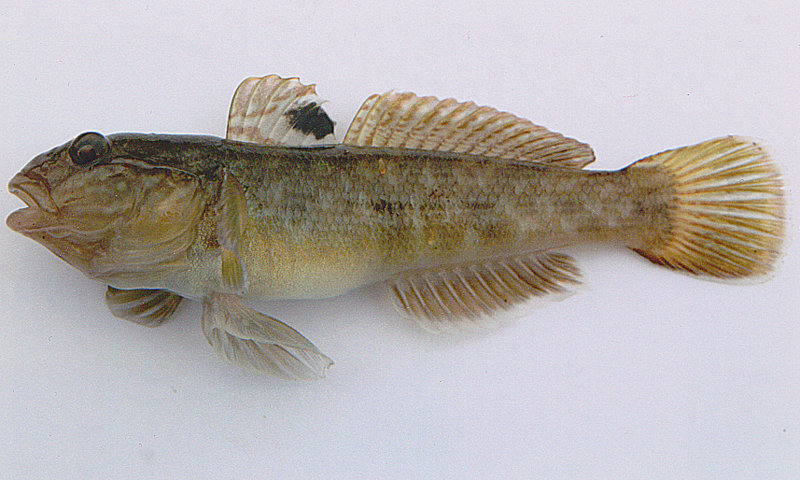
Robust, cylindrical body anteriorly, with a large, broad head — the "round" appearance from which the common name derives. Massive head with prominent bulging eyes on the upper surface. Very wide mouth. Lower jaw often with a dark tinge — from which the scientific name "melanostomus" (black mouth) is derived. Essential diagnostic feature: a large, round black spot on the posterior margin of the first dorsal fin (absent in most other gobies). Pelvic fins fused into a functional adhesive disc. Colouration highly variable: brownish-grey, olive, or grey with complex blotches and marbling. Breeding males turn almost entirely black. Usual dimensions 12–18 cm, maximum 20–25 cm.

Habitat & Distribution

Native Ponto-Caspian species. In Romania, extremely abundant in the lower Danube, the Danube Delta, the coastal Black Sea, and all connected waters. Prefers hard substrates: gravel, stones, rubble, boulders — avoids exclusively muddy bottoms. Depth 0.5–20 metres. Tolerates a wide range of salinities (fresh to fully marine). The most invasive goby globally: has colonised the Baltic Sea (1990s), the North American Great Lakes (1990), the upper Danube, the Rhine, and numerous other basins through shipping (ballast water).

Behavior & Diet

Specialist benthic carnivore focused on molluscs but also opportunistic: zebra mussels Dreissena polymorpha (dominant prey component), snails, crustaceans, insect larvae, fish eggs, fry, and small fish. Crushes mussel shells with powerful pharyngeal teeth. Competes directly with common carp for mussels. Active day and night. Territorial and aggressive towards other benthic species during the breeding season. Prey for large pike, pike-perch, and perch, as well as piscivorous birds.

Life Cycle & Reproduction

Maturity at 1–2 years, 8–12 cm. Very long breeding season: April–September, peak May–July. The male prepares a nest under stones or in cavities and guards it aggressively. Females may deposit 300–5000 eggs in 2–6 batches per season. Hatching after 7–20 days. Benthic larvae. Fast growth: 8–12 cm in the first year. Lifespan 4–5 years. High fecundity and long breeding season explain global invasive success.

Conservation Status

Least Concern (LC) in its native range. Extremely abundant in Romania with no threats. In invasive zones, considered one of the most damaging invasive species — consuming eggs of valuable species (salmon and trout in the Great Lakes), reducing native mussel populations, and restructuring benthic ecosystems. Control measures in North America and Western Europe, but expansion continues. Its global invasion makes it an intensively studied subject in invasion biology.

Sources

  • FishBase: Neogobius melanostomus
  • Wikipedia: Round goby
  • Scientific publications on round goby invasion biology