Fish

Broadnosed Pipefish

Syngnathus typhle

Broadnosed Pipefish

Overview

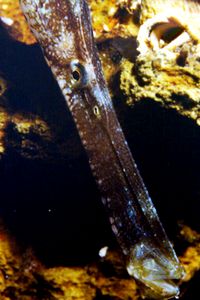
The broadnosed pipefish (*Syngnathus typhle*) is a close relative of the seahorse, with an equally unusual appearance and fascinating reproductive behaviour. It is a highly specialized fish whose entire existence depends on the presence of submerged vegetation. Its thin, rigid body, resembling a stem, allows it to hide perfectly among seaweed, making it one of the best examples of mimicry in the Delta and coastal fauna.

Physical Characteristics

The body is very long, thin, and covered with bony plates forming protective armour, making it somewhat inflexible. The distinctive feature is the long, laterally flattened snout (much wider than in other pipefish species), giving it the English name "broadnosed". Coloration varies from olive-green to brown, often with spots or fine stripes, adapting to the colour of the vegetation it lives in. It lacks ventral fins.

Habitat & Distribution

Found along European coasts, from Norway to the Mediterranean and Black Sea. In the Danube Delta and Razim-Sinoe complex, it is closely linked to seagrass meadows (Zostera) and areas with green algae. It prefers calm, shallow waters (1-20 metres) where currents are not very strong.

Behavior & Feeding

It is a slow swimmer that moves vertically or obliquely, mimicking the sway of plants in the current. It feeds by suction: the snout works like a pipette that suddenly sucks in prey (small crustaceans, copepods, or fish larvae). Due to its limited mobility, it relies exclusively on camouflage to avoid predators.

Life Cycle & Reproduction

The broadnosed pipefish has a reversed reproductive system: the female courts the male. She deposits eggs into the brood pouch on the male's abdomen. The male fertilizes the eggs and carries them for about 4 weeks, providing oxygen and nutrients through the pouch tissues. At the end, the male "gives birth" to live young, which are perfect miniatures of adults and become independent immediately.

Conservation Status

Although classified as Least Concern (LC), the broadnosed pipefish is vulnerable to habitat loss. Destruction of seagrass meadows through dredging, pollution, or eutrophication leads automatically to the disappearance of local populations. It is considered an indicator species for the health of coastal and lagoon ecosystems.