Birds

Greater Spotted Eagle

Clanga clanga

Greater Spotted Eagle

General Overview

The great screaming eagle is one of the rarest and most endangered eagles in Europe. As a wetland and swamp forest specialist, the Danube Delta represents a critical stopover habitat during its migration. It is more robust and darker in color than its more common relative, the lesser screaming eagle, and has a much more reclusive lifestyle. In Romania, its presence is rare and is limited to periods of passage or mild winters, being an absolute priority for biodiversity conservation at the European level.

Physical Characteristics

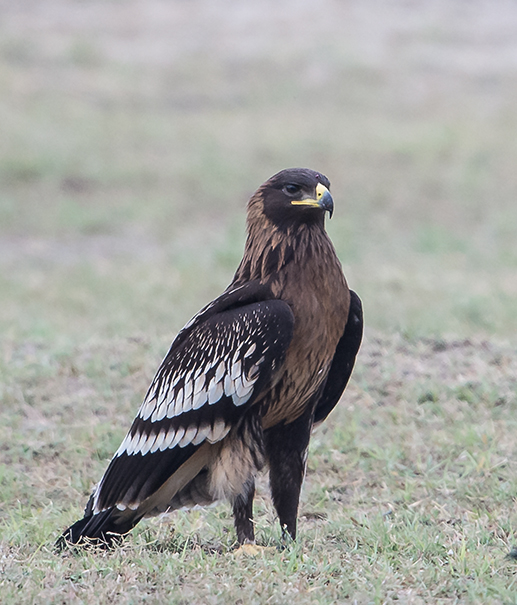
A medium-sized eagle with uniformly dark brown plumage, often appearing almost black at distance. Distinguished from the Lesser Spotted Eagle by larger size, broader wings, and a more prominent white rump patch. Juveniles show large, conspicuous white spots on the wing coverts. The nostril is rounded, characteristic of the genus Clanga. Flight appears heavy, with deep wingbeats. The overall impression in the field is of a dark, broad-winged eagle with a deliberate, powerful flight action.

Habitat & Distribution

Breeding range extends from Poland and Belarus east across Russia, favouring floodplain forests and extensive marshes. In Romania, the Danube Delta provides ideal resting habitat during migration toward African or southern European wintering grounds. Some individuals may overwinter. Prefers very undisturbed areas, away from human activity, hunting in flooded areas and lake margins. The global population is estimated at only 3,800–4,600 breeding pairs, making every sighting in the delta conservation-relevant.

Behaviour & Feeding

A versatile hunter, capable of taking prey in flight, on the ground, or from water. Diet includes small mammals (water voles, mice), waterbirds (ducks, coots), amphibians, and fish. Unlike many eagles, it can often be seen walking on the ground in search of prey. Solitary and very secretive, much harder to observe than the Lesser Spotted Eagle. During migration it may associate loosely with other raptors but generally maintains a low profile, resting in dense reed beds or forested margins.

Life Cycle & Reproduction

Does not breed in Romania; the nearest breeding sites are in eastern Poland and Ukraine. Builds large nests in trees in inaccessible, flooded areas. Lays 1–2 eggs; usually only one chick survives. A concerning phenomenon for the species is frequent hybridisation with the Lesser Spotted Eagle (Clanga pomarina), driven by population decline and difficulty finding conspecific mates. Hybrid offspring are fertile and create serious identification challenges, further complicating population monitoring efforts.

Conservation Status

Classified as Vulnerable (VU) globally, the species faces extinction risk from wetland destruction, fragmentation of floodplain forests, and human disturbance. The Danube Delta plays a vital role as a foraging and recuperation site during its long migration. Maintaining strict protection zones and careful monitoring of passage individuals are essential for international conservation efforts. The species is listed in the EU Birds Directive Annex I and is the subject of a dedicated European Action Plan coordinated by BirdLife International.

Sources

  • BirdLife International — Greater Spotted Eagle
  • IUCN Red List
  • SOR.ro — Greater Spotted Eagle
  • Action Plan for the Greater Spotted Eagle in Europe
  • Wikipedia.org