Birds

Eastern Imperial Eagle

Aquila heliaca

Eastern Imperial Eagle

Overview

The field eagle, also known as the imperial eagle, is one of the rarest and most valuable birds of prey in Europe. Once a symbol of the Romanian steppes, the species was on the verge of extinction in our country. It is a large, imposing eagle that prefers open plains and steppe areas to mountains. Any sighting of this species in Dobrogea or in the vicinity of the Danube Delta is an event of major conservation importance, signaling the success of reintroduction efforts in the region.

Physical Characteristics

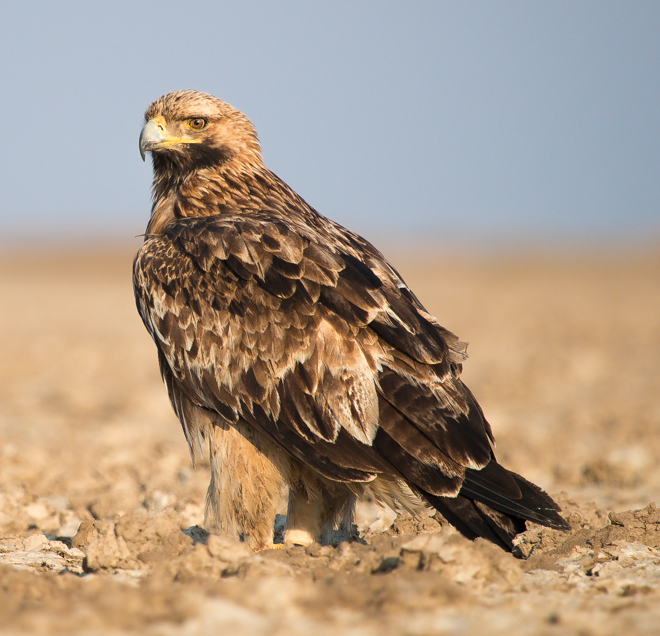
A massive, dark brown eagle — almost black in adults. Unmistakable "white shoulders" (white scapular patches) and a pale creamy-yellow nape that contrast sharply with the dark body. The tail is dark grey with fine black bands. Juveniles are much paler, with ochre-buff streaked plumage often confused with other eagle species. A powerful bill and the characteristic imperious gaze of a top predator.

Habitat & Distribution

Range spans Central Europe to Central Asia. In Romania, considered extinct as a breeding species for decades, but recently resumed nesting in western Romania and Dobrogea. Prefers plains and steppe with isolated trees or small woodland patches. The Danube Delta and adjacent steppe zones offer ideal hunting and passage habitat — particularly ground squirrel colonies which are a key food source.

Behaviour & Diet

A specialised steppe hunter. Preferred prey is the European ground squirrel (Spermophilus citellus), but also takes hares, hamsters and ground-nesting birds (bustards, quail). Carrion is consumed frequently in winter. Hunts by soaring at height or waiting on an elevated perch. Territorial; pairs bond for life and defend their nest area fiercely.

Life Cycle & Breeding

Nests high in isolated trees in open farmland — making the nest highly visible and vulnerable to human disturbance. Lays 2–3 eggs in March–April. Incubation lasts approximately 43 days. Usually 1–2 chicks fledge. Young reach sexual maturity at 5–6 years. Adults may remain near their territory in winter, while young birds wander over large distances.

Conservation Status

Classified Vulnerable (VU) globally. Main threats in Romania: electrocution on uninsulated power lines, illegal use of poison baits and destruction of ground squirrel colonies — the primary food source. Cross-border conservation projects have stabilised the population in Eastern Europe. The Danube Delta and Dobrogea are essential as an expansion corridor for this magnificent species.

Sources

  • BirdLife International — Eastern Imperial Eagle
  • SOR.ro — Acvila de câmp
  • Milvus Group — Conservation programmes
  • IUCN Red List
  • Wikipedia.org