Fish

Ship Sturgeon

Acipenser nudiventris

Ship Sturgeon

Record > http://www.fishing-worldrecords.com/scientificname/Acipenser%20nudiventris/show

General Overview

**PHANTOM STURGEON - CONSIDERED EXTINCT IN ROMANIA AND BULGARIA!** Ship sturgeon **WAS NEVER ABUNDANT** in the Danube basin. **LAST ROMANIAN CAPTURE**: 1950 (scientific record)! **Exception**: mid-2000s - approximately 100 kg specimen caught at Iron Gates BUT ended up on poachers' plates! **LAST DOCUMENTED EUROPEAN CAPTURE**: 2009 near Mohacs, Hungary (Middle Danube). **NO document** attesting to captures in lower Danube basin Romania in **last 30-40 years**! **CATALOGUED EXTINCT** in Romania and Bulgaria. **POSSIBLY COMPLETELY EXTINCT FROM DANUBE** - on the brink of total extinction! **CRITICALLY ENDANGERED (CR)!** **Total prohibition 2006-2026!** Characteristic: resembles sterlet (*A. ruthenus*) BUT lower lip **NOT crested** (entire)! Lived in sea near shores and estuaries; in freshwater preferred deep channels of large rivers. Considered **MOST FERTILE sturgeon species**! **REINTRODUCTION PROGRAM**: international efforts aimed at reintroduction through captive breeding. Hopeless without massive restocking!
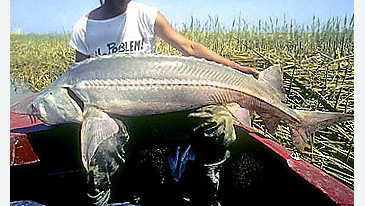
Physical Characteristics

Unique feature: abdomen lacking ventral bony plates (scutes) — hence the name "nudiventris" (bare belly)! Fringed barbels (whiskers) — another distinctive characteristic compared to other sturgeon species. Moderately massive, elongated body. Medium-length snout. Medium inferior mouth. 5 rows of bony scutes: dorsal, 2 lateral, with absent or greatly reduced ventral 2 rows. Coloration: brownish-grey back, pale abdomen. Typical dimensions: 0.8-1.5 m, 10-40 kg. Maximum: 2 m, 80 kg.

Habitat & Distribution

Anadromous species from the Pontic-Caspian basin. Historical distribution: Black Sea, Azov Sea, Caspian Sea, with migrations into the Danube, Dnieper, Ural, Kura, Syr Darya, Amu Darya. Today: extinct or extremely rare in the Danube and Black Sea basin. Most recent documented captures: Hungary 2009. The Caspian Sea basin population (Iran, Kazakhstan) is more numerous but also declining. Prefers sandy and muddy bottoms in estuarine zones, at moderate depths.

Behavior & Diet

Benthic carnivore: polychaete worms, bivalve molluscs, crustaceans, rarely small fish. Fringed barbels are specialised sensory organs for detecting prey in sediment. Anadromous migratory behaviour: enters rivers from the sea in spring for reproduction. Maturity: males 10-14 years, females 12-17 years. Partly potamodromous: some populations may spend extended periods in fresh water. Interval between spawnings: 3-5 years.

Life Cycle & Reproduction

Sexual maturity: males 10-14 years, females 12-17 years. Spring spawning (May-June) on rocky bottom with moderate current. The most fertile sturgeon species: female deposits 500,000-7,000,000 eggs! Small, black, adhesive eggs. Hatching after 5-10 days. Interval between spawnings: 3-5 years. Moderate growth. Longevity 30-40 years. Extraordinary fertility partially compensates for high mortality, but not sufficiently to counteract anthropogenic pressures.

Conservation Status

Critically Endangered (CR) — critically endangered, practically extinct from the Danube! Considered extinct from Romania and Bulgaria. Last capture in the Danube: Hungary 2009. Total fishing prohibition in Romania 2006-2026 (Order 545/715/2016). Threats: (1) Iron Gates dams, (2) Poaching, (3) Severe pollution of the Danube, (4) Destruction of spawning habitats. Conservation efforts are difficult due to the extremely small number of remaining specimens. Any accidental capture must be immediately reported to authorities — it may be the only specimen in the region!

Sources

  • IUCN Red List: Critically Endangered
  • WWF Romania: LIFEBoat 4 Sturgeons
  • Order 545/715/2016: Sturgeon prohibition Romania
  • FishBase: Acipenser nudiventris