Fish

European Sea Sturgeon

Acipenser sturio

European Sea Sturgeon

General Overview

**THE RAREST STURGEON SPECIES IN THE WORLD!** The European sea sturgeon is **OFFICIALLY DECLARED EXTINCT FROM THE DANUBE** in Romania's Red Book of Vertebrates! In the Black Sea basin **ALWAYS the rarest sturgeon species**, documented presence ONLY until **early twentieth century**! **LAST DOCUMENTED EUROPEAN CAPTURE**: 1954 - Serbian part of the Danube! **NOT captured in Romania for OVER 60 YEARS!** **ONLY EXISTING WILD POPULATION**: Garonne and Dordogne rivers, France - LAST REFUGE! Historical vast distribution: Atlantic Ocean, English Channel, Mediterranean Sea, Black Sea - ascended **ALL major rivers** for reproduction. **TODAY: NEARLY EXTINCT!** **CRITICALLY ENDANGERED (CR)!** **Total prohibition 2006-2026** (includes European sea sturgeon even though extinct!). We know it reproduced in the Lower Danube - in the 1930s **hybrid specimens** with other Danube sturgeons were described (proof of reproduction!). Migrated in rivers January-October, migration peak April-May (high water levels). In sea preferred muddy estuaries. **REINTRODUCTION EFFORTS**: international captive breeding programs for salvation from complete extinction!
Physical Characteristics

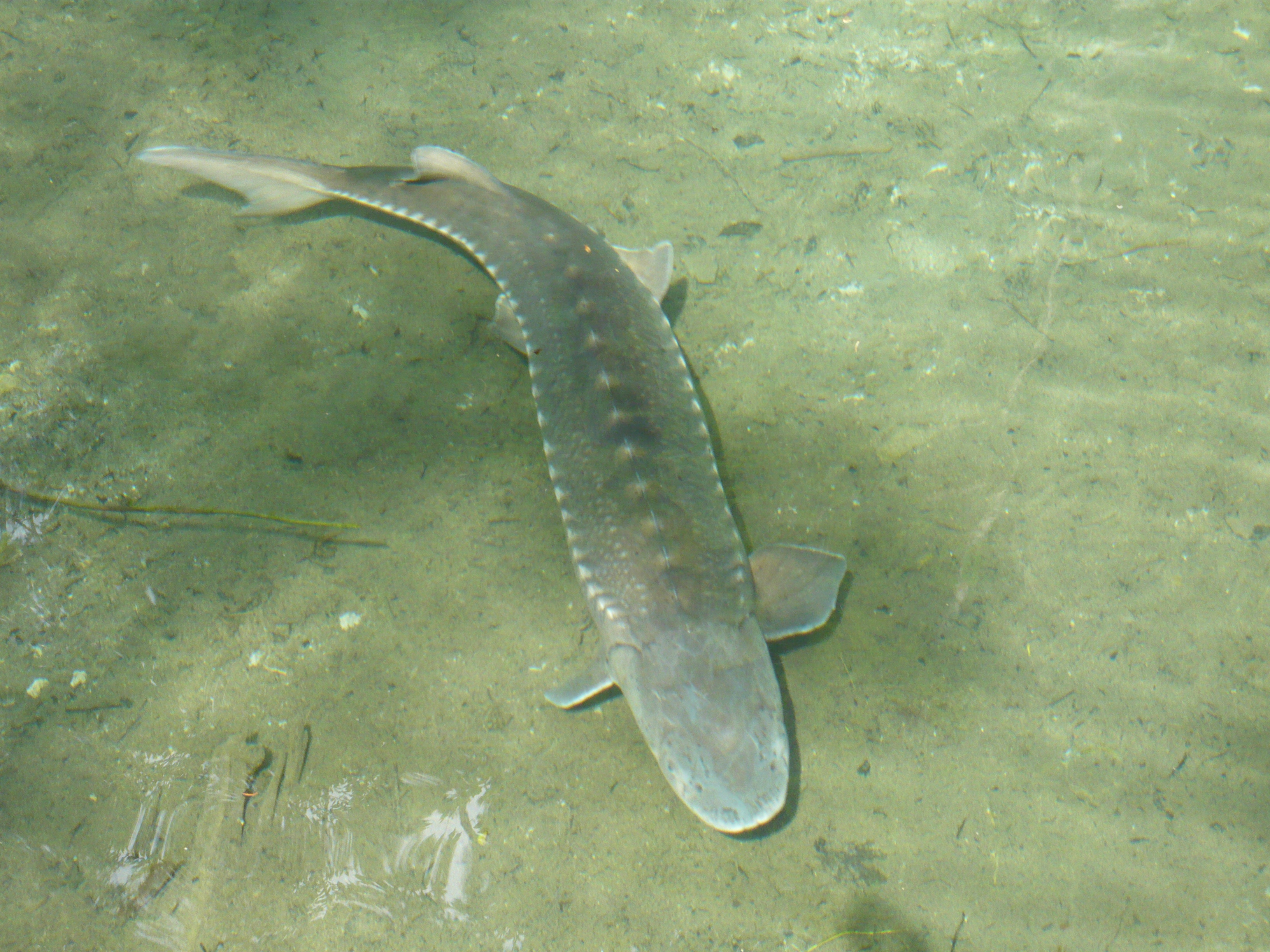
Elongated, powerful body. Long, conical, moderately pointed snout. Tubular, protractile inferior mouth. 4 barbels (whiskers) positioned in front of the mouth, closer to the snout tip than to the mouth. 5 rows of bony scutes (plates): 1 dorsal (9-16), 2 lateral (24-40), 2 ventral (9-13). Cartilaginous skeleton. Coloration: brownish-grey back, whitish abdomen. Sexual dimorphism: females larger than males. Typical dimensions: 1.5-3 m, 50-200 kg. Historical maxima: 6 m, 400 kg.

Habitat & Distribution

Anadromous species with historically extensive distribution: all of Europe — from northern Scandinavia and the British Isles, through the Baltic Sea, Atlantic, Mediterranean Sea, to the Black Sea. Migrated into major rivers: Rhine, Elbe, Oder, Vistula, Danube, Dnieper, Loire, Gironde. Today: vanished from almost its entire historical range! Only wild population: the Gironde-Garonne-Dordogne river system in France. Disappeared from the Danube and Black Sea basin since the 1950s. Last capture in the Danube: 1954.

Behavior & Diet

Benthic carnivore: feeds on the bottom with polychaete worms (in the sea), crustaceans, molluscs, insect larvae (in fresh water). The long, sensitive snout explores sediments to detect prey. Annual anadromous migrations: enters rivers from the ocean in spring for reproduction. Late maturity: males 7-12 years, females 12-18 years. Remarkable longevity: 70-100 years. Interval between spawnings: 2-3 years.

Life Cycle & Reproduction

Maturity: males 7-12 years, females 12-18 years. Spring-summer spawning (May-July) on rocky river bottoms with current. Female deposits 800,000-6,000,000 small, black eggs. Hatching after 3-7 days. Larvae initially live in fresh water, gradually descending to estuaries, then entering the ocean. Slow growth. Longevity 70-100 years. Does not spawn annually — 2-3 year intervals. The Gironde population benefits from an intensive artificial reproduction and restocking programme in France.

Conservation Status

Critically Endangered (CR) — critically endangered, on the verge of extinction! Extinct from the Danube and Black Sea basin. Only wild population: Gironde, France (a few hundred individuals). Total prohibition in Romania 2006-2026 (Order 545/715/2016). Causes of extinction: (1) Dams on all major European rivers, (2) Centuries of intensive fishing, (3) Pollution, (4) River dredging. European LIFE+ Sturgeon programme in France: artificial reproduction, restocking, monitoring. Reintroduction efforts exist for the Rhine and Elbe. A symbol of extinction caused by human activities.

Sources

  • IUCN Red List: Critically Endangered
  • LIFE+ Sturgeon Programme: France
  • Order 545/715/2016: Sturgeon prohibition Romania
  • FishBase: Acipenser sturio