Fish

Starry Sturgeon

Acipenser stellatus

Starry Sturgeon

© Zoltán Sallai > https://termeszetvedelem.hu/talalati-oldal/?type=vedett-fajok&id=1278

General Overview

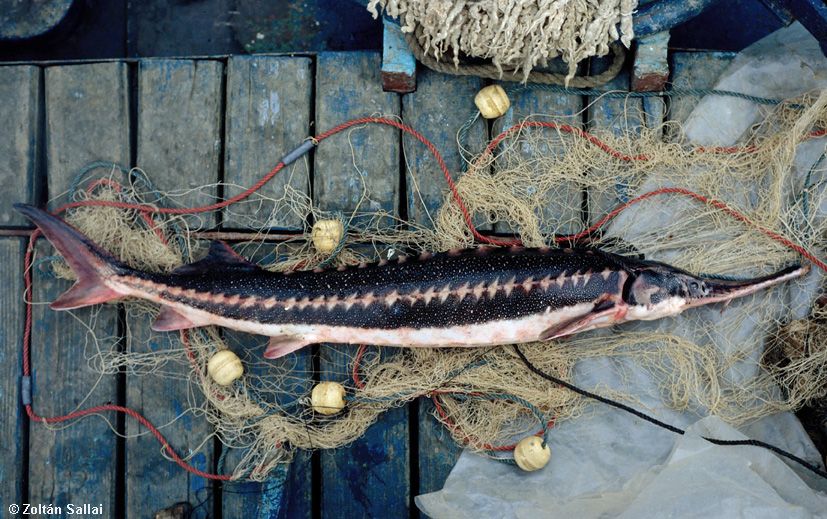
The starry sturgeon is an anadromous sturgeon from the Black, Caspian, and Azov seas, characterized by **an elongated, narrow, dorso-ventrally flattened snout** - an easily recognizable diagnostic feature! Body covered with **5 rows of rhombic pectinate and stellate bony plates** (hence "stellatus" = starred). Short fringed barbels. Interrupted inferior jaw, superior jaw ~60% of inferior length. Anadromous migrations: from sea to Danube for reproduction. **HISTORICALLY**: ascended in Danube tributaries - Prut, Siret, Olt, Jiu, Tisa, Cris! **TODAY**: blocked by dams! **2 migration periods**: spring (March-May, max April) and autumn (August-October - more intense!). Benthic in sea and lower river courses BUT can be found in upper water layers - UNIQUE among sturgeons! **CRITICALLY ENDANGERED (CR)!** **Total prohibition 2006-2026!** **Interbreeds with ALL sturgeons** - beluga, sterlet, Russian sturgeon - possible hybrids! High quality roe. **Restocking program**: 2013-2025 - 10,000+ fry annually (Borcea, Isaccea). Longevity record: 23 years (northwest Black Sea).
Physical Characteristics

Distinctive feature: long, narrow, pointed snout — unique among Danube sturgeons! Slender body, less massive than Russian sturgeon or beluga. Lateral bony plates with characteristic star shape, more prominent than other species. 5 rows of bony scutes: 1 dorsal (10-14), 2 lateral (26-43), 2 ventral (9-11). 4 long barbels without fringes, positioned close to the tip of the snout. Small inferior mouth. Coloration: brownish-grey back with yellowish tints, white abdomen. Typical dimensions: 0.8-1.5 m, 10-30 kg.

Habitat & Distribution

Anadromous species characteristic of the Black Sea, Azov and Caspian basins. Migrations into rivers: Danube (principal in the Black Sea basin!), Dnieper, Dniester, Don, Rioni, Kura, Volga. Distinctive feature: two annual migrations — spring (March-May) and autumn (September-November). The Iron Gates dams have severely fragmented habitats. Prefers coastal marine zones and estuaries, sandy or muddy bottoms at moderate depths. Present in the lower Danube sector during migration periods.

Behavior & Diet

Benthic carnivore: feeds mainly on bivalve molluscs (clams), crustaceans, polychaete worms, rarely small fish. Feeding occurs on the sea and river bottom. Uses long snout to probe sediments in search of prey. Annual migrations in two waves (spring and autumn). Males mature at 8-10 years; females 9-12 years. Natural hybridisation possible with Russian sturgeon and sterlet. Interval between spawnings: 1-2 years (shortest among large sturgeons).

Life Cycle & Reproduction

Sexual maturity: males 8-10 years, females 9-12 years — earlier than beluga or Russian sturgeon. Spring spawning (May-June) and some specimens also in autumn, on rocky bottom with current. Female deposits 60,000-600,000 small, black eggs. Adhesive eggs on hard substrate. Hatching after 8-12 days. Interval between spawnings: 1-2 years. Relatively fast growth for a sturgeon. Longevity 20-27 years. Natural hybrids (with Russian sturgeon, sterlet) are fertile and viable, complicating species identification.

Conservation Status

Critically Endangered (CR) — severe population collapse in the Danube and Black Sea. Total fishing prohibition 2006-2026 by Order 545/715/2016! Threats: (1) Iron Gates dams — blocking 80% of reproduction habitats, (2) Ruthless poaching — eggs ("sevruga") worth thousands of euros per kg, (3) Pollution, (4) Destruction of coastal habitats. LIFEBoat 4 Sturgeons programme: restocking, monitoring, gene bank. Hybridisation with other species may complicate conservation efforts. Accidental capture — mandatory release, reporting!

Sources

  • IUCN Red List: Critically Endangered
  • WWF Romania: LIFEBoat 4 Sturgeons
  • Order 545/715/2016: Sturgeon prohibition Romania
  • FishBase: Acipenser stellatus