Fish

European Grayling

Thymallus thymallus

European Grayling

General Overview

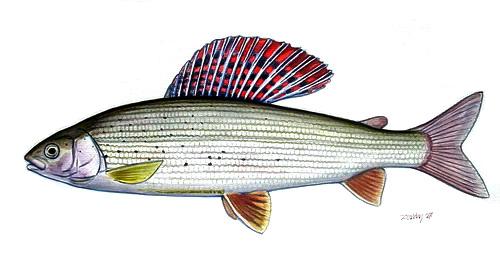
The European grayling is a freshwater salmonid similar to trout, with a **spectacular tall, multicoloured dorsal fin** — the most striking dorsal among salmonids. **IMPORTANT:** Although historically listed for the Danube Delta, its current presence in the lower Danube sector is highly doubtful or absent. Grayling requires **cold, fast, clear, well-oxygenated water** — conditions absent in the Danube Delta. Natural habitat: fast mountain streams below trout zone. In Romania still present in: Moldova, Suceava, Bistrița, Dorna, Jiu, Cerna, Timiș, Vișeu, Tisa, Someș, Criș, Arieș, upper Mureș. **Protected since 2010** — mandatory release if caught. Sharp decline due to pollution, dams, habitat degradation. Restocking underway (Făgărași 2021: 500 individuals).

Physical Characteristics

Elongate body, slightly laterally compressed. Relatively large scales. Small head, pointed snout. Small transverse, semi-inferior mouth. Spectacular feature: long-based, very tall, multicoloured dorsal fin — violet, red, blue. Adipose fin present (salmonid). Deeply forked caudal. Coloration: greenish-grey back, yellowish-red or violet-silver flanks, silver-white belly. Size: typically 25-35 cm, rarely 40-50 cm.

Habitat & Distribution

Wide European range: France to Russia. In Romania: fast mountain streams below trout zone. Does not live in stagnant water — avoids lakes. Requires cold water (4-18°C), clear, well-oxygenated, fast-moderate current, rocky/gravel bottoms. Presence in the Danube Delta is highly doubtful.

Behavior and Feeding

Specialist insectivorous carnivore: molluscs, small crayfish, aquatic insects (mayfly, caddisfly, stonefly larvae) and aerial insects — leaps acrobatically after insects above the surface. Small mouth cannot eat fry (unlike trout). Juveniles in groups, adults solitary.

Life Cycle & Reproduction

Maturity at 3-4 years. Spring spawning (March-May) on gravel in fast, cold water. Female digs a pit in gravel. Eggs deposited in gravel. No parental care. Hatching after 3-4 weeks. Longevity 10-15 years.

Conservation Status

Protected in Romania since 2010. Sharp population decline. Mandatory release if caught accidentally. Threats: water pollution, dams (habitat fragmentation), habitat degradation, illegal fishing. Restocking underway (Făgărași 2021: 500 individuals).

Sources

  • FishBase: Thymallus thymallus
  • Romanian fishing legislation (protection 2010)
  • Făgărași restocking projects (2021)